

ECEGEN Genetic Services
Cancer Genetics and Hereditary Cancers
We assess hereditary cancer risk and analyze the tumor's genetic profile to help identify targeted drugs and treatment options.
Cancer is the most complex genetic disease of our time. Worldwide, one in five deaths is caused by cancer. Environmental factors (such as smoking, radiation exposure, and poor nutrition), together with genetic factors, play an important role in the development of cancer. Between 5–10% of all cancers are hereditary. In other words, cancer arises through changes in genes and can be passed on to subsequent generations. The occurrence of cancer in one individual as a result of genetic mutations should raise concern that other family members may also be at risk of developing cancer.

In Which Situations Should Cancer Patients Undergo Genetic Testing?
- Multiple occurrences of the same cancer type in the family
- Cancers that typically occur at advanced ages appearing in young individuals (e.g., colon cancer in a 20-year-old)
- The occurrence of more than one type of cancer in a single individual (e.g., patients diagnosed with both breast and ovarian cancer)
- Bilateral cancer development in paired organs (e.g., both breasts or kidneys)
- The occurrence of multiple childhood cancers among siblings (such as a sarcoma diagnosis in two siblings)
- Occurrence of cancer in an unusual gender (e.g., male breast cancer)
What Are the Benefits of Genetic Testing for Cancer Patients?
Genetic tests performed in cancer patients allow a definitive diagnosis to be established in some cases where clinical findings are otherwise unclear.
In relatives of individuals who have been diagnosed with cancer and found to carry a relevant genetic alteration through genetic testing, it should be investigated whether the same alteration is present. Routine cancer screening should be recommended for individuals at risk of cancer. The aim is to take risk-reducing measures based on genetic test results, enabling early detection and appropriate treatment for patients.
How Do We Support Targeted Drug Selection in Cancer Treatment?
We analyze genetic alterations detected in tumor tissue or blood to identify actionable biomarkers. These findings can support the evaluation of suitable targeted drugs and therapies, help avoid potentially ineffective treatments, and contribute to a personalized treatment plan.
Genetic Tests Guiding Cancer Treatment
- Colorectal Cancer Mutation Panel (KRAS, BRAF, NRAS)
- Non-Small Cell Lung Cancer (EGFR, EML4-ALK, KRAS, ROS1)
- Breast Cancer (Her2/Neu FISH Analysis)
- Papillary Thyroid Cancer (BRAF)
- Melanoma (BRAF)
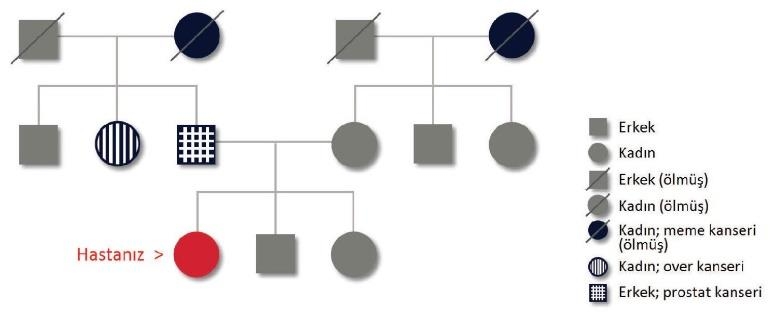
What Are Cancer Screening Panels Used For?
The same cancer, or similar or different types of cancer, may occur in more than one member of a family. Cancer screening test panels allow multiple genes associated with a given type of cancer to be examined simultaneously for diagnostic purposes.
Hereditary Cancer Test Panels
- Breast and Ovarian Cancer Screening Panel
- Colorectal Cancer Screening Panel
- Endometrial Cancer Screening Panel
- Prostate Cancer Screening Panel
- Comprehensive Hereditary Cancer Screening
Certain Hereditary Cancer Syndromes
Hereditary Breast and Ovarian Cancer
Breast cancer is the most common cancer among women worldwide and in our country, and it ranks first among causes of cancer death in women. A family history is an important risk factor for breast cancer, and 5-10% of cases are known to be familial. While the lifetime risk of breast cancer in women is around 12%, the risk of ovarian cancer is approximately 1.4%. In women carrying a BRCA1 mutation, the risk of breast cancer is reported to be 71-85%, and the risk of ovarian cancer 40-45%. Similarly, in the presence of BRCA2 gene mutations, the risk of breast cancer is reported to be 80-85%, and the risk of ovarian cancer 10-27%.
Hereditary Colorectal Cancer Syndromes
Of hereditary colorectal cancer cases, 70-85% occur sporadically and 15-30% are hereditary. Colorectal cancer syndromes account for 2-5% of all colorectal cancers.
Lynch syndrome (Hereditary Nonpolyposis Colon Cancer - HNPCC) is the most common genetic form of colorectal cancer, seen in 2-4% of all colorectal cancer cases. Lynch syndrome arises as a result of mutations in one of the DNA mismatch repair genes (MLH1, MSH2, MSH6, or PMS2).
Familial adenomatous polyposis (FAP) is characterized by numerous (>100) premalignant colorectal adenomatous polyps and results from mutations in the APC gene. FAP is inherited in an autosomal dominant manner. Attenuated FAP (AFAP) is considered a subgroup of FAP patients, in whom the number of colorectal adenomas (<100) is lower. Mutations in the MUTYH gene cause MUTYH-associated polyposis.
Familial Gastrointestinal Stromal Tumor (GIST)
Gastrointestinal stromal tumor (GIST) is the most common mesenchymal tumor of the gastrointestinal system, occurring predominantly in the stomach (40-70%), small intestine (20-40%), colon and rectum (5-15%), omentum/mesentery (7%), and esophagus (<5%). It is a rare cancer characterized by mutations in the KIT, PDGFRA, SDHB, and SDHC genes.
Familial Pancreatic Cancer
Although rare, this cancer has high mortality rates. It is projected to rank second among cancers causing mortality worldwide by 2030. Approximately 10% of cases are hereditary.
An increased risk of pancreatic cancer has been reported in cases of Lynch syndrome, Peutz-Jeghers syndrome, familial adenomatous polyposis, hereditary melanoma, and hereditary breast-ovarian cancer. BRCA1 gene mutations increase the risk of prostate cancer 3.8-fold, while BRCA2 gene mutations increase it 8.6-fold. In addition, recent studies have reported that more than 10% of individuals with metastatic prostate cancer carry mutations in DNA repair genes.
Familial Prostate Cancer
Prostate cancer is the most common non-cutaneous cancer in men. It is hereditary in 5-10% of all cases. The presence of first-degree relatives affected by prostate cancer across three consecutive generations on either the maternal or paternal side, its occurrence at a young age, and a family history of cancers such as breast, ovarian, or pancreatic cancer indicate that prostate cancer arises from genetic factors. Pathogenic mutations may be found in the BRCA1, BRCA2, and HOXB13 genes.
Multiple Endocrine Neoplasia Type 1
Multiple Endocrine Neoplasia Type 1: This is a disease with autosomal dominant inheritance. Tumors occur in the endocrine glands and in certain parts of the small intestine and stomach. Mutations in the MEN1 gene are found in 80-90% of familial cases.
Multiple Endocrine Neoplasia Type 2
Multiple Endocrine Neoplasia Type 2: There are three types — MEN 2A, FMTC (familial medullary thyroid carcinoma), and MEN 2B. All types carry a high risk of medullary thyroid cancer. There is an increased risk of pheochromocytoma in MEN 2A and MEN 2B, and an increased risk of parathyroid adenoma or hyperplasia in MEN 2A. Mutations in the RET proto-oncogene can be detected in 98% of MEN2A cases, 95% of FMTC cases, and 98% of individuals diagnosed with MEN2B.
Li-Fraumeni Syndrome
Li-Fraumeni syndrome (LFS) results from mutations in the TP53 gene and shows autosomal dominant inheritance. It is a disease characterized by the emergence of various types of cancer beginning at a young age in affected individuals. Soft tissue sarcoma, osteosarcoma, premenopausal breast cancer, brain tumors, adrenocortical carcinoma (ACC), and leukemias may occur.
Testing Criteria:
- Detection of a tumor within the LFS tumor spectrum before age 45 in the individual
- Detection of one or more cancer types within the LFS tumor spectrum before age 56 in at least one first- or second-degree relative (excluding breast cancer if the proband has breast cancer)
- Detection of multiple tumors in the proband (excluding multiple breast cancers), where two of the cancer types belong to the LFS spectrum and occurred before age 45
- The presence of adrenocortical carcinoma, choroid plexus tumor, or embryonal anaplastic subtype rhabdomyosarcoma in the patient, regardless of family history
- Diagnosis of breast cancer before age 30
Hereditary Renal Cancer Syndromes
Hereditary kidney cancer accounts for 3-5% of all kidney cancers. Birt-Hogg-Dubé syndrome (FLCN), hereditary papillary renal cancer (MET), tuberous sclerosis complex (TSC1, TSC2), Von Hippel-Lindau syndrome (VHL), and PTEN hamartoma syndrome (PTEN) can be counted among the hereditary renal cancer syndromes.
Birt-Hogg-Dubé Syndrome
This is a rare genetic disease characterized by skin tumors, including multiple fibrofolliculomas, trichodiscomas, and acrochordons or skin tags. Mutations in the FLCN gene are found in 88% of cases. It shows autosomal dominant inheritance.
PTEN Hamartoma Tumor Syndrome
This syndrome encompasses Cowden syndrome (CS), Bannayan-Riley-Ruvalcaba syndrome (BRRS), PTEN-related Proteus syndrome (PS), and Proteus-like syndrome. PTEN gene mutations are found in 25-80% of Cowden syndrome cases, 60% of BRRS cases, 50% of PLS patients, and 20% of PS cases.
- Cowden Syndrome: A multiple hamartoma syndrome carrying a high risk of benign and malignant tumors of the thyroid, breast, and endometrium. The lifetime risk of breast cancer is reported to be 85%, the risk of thyroid cancer 35%, and the risk of endometrial cancer 28%.
- BRRS (Bannayan-Riley-Ruvalcaba Syndrome): A congenital disease characterized by macrocephaly, intestinal hamartomatous polyposis, and lipomas.
- Proteus Syndrome: A complex disorder defined by congenital malformations and hamartomatous overgrowth of various tissues.
- Proteus-like Syndrome: Refers to individuals who resemble Proteus syndrome but do not meet the diagnostic criteria for Proteus syndrome.
References
- Genetic Testing for Hereditary Cancer Syndromes — National Cancer Institute
- American Cancer Society medical information (Last Medical Review: March 25, 2017 / Last Revised: January 4, 2018)
- Lu KH, Wood ME, Daniels M, Burke C, Ford J, Kauff ND, Kohlmann W, Lindor NM, Mulvey TM, Robinson L, Rubinstein WS, Stoffel EM, Snyder C, Syngal S, Merrill JK, Wollins DS, Hughes KS, American Society of Clinical Oncology. J Clin Oncol. 2014 Mar 10; 32(8):833-40.
- Amundadottir LT. Pancreatic Cancer Genetics. International Journal of Biological Sciences. 2016;12(3):314-325. doi:10.7150/ijbs.15001
- Şahin Fİ. Genetic Counseling in Hereditary Cancers. Türkiye Klinikleri J Med Genet-Special Topics 2017;2(2):107-12.
- Giri VN, Hyatt C, Kelly WK. Current BRCA1/2 Genetic Testing Guidelines for Prostate Cancer and Implications for Oncologists. 2017.
- Genetics of Prostate Cancer — National Cancer Institute
- Bougeard G, Renaux-Petel M, Flaman JM, Charbonnier C, Fermey P, Belotti M, Gauthier-Villars M, Stoppa-Lyonnet D, Consolino E, Brugières L, Caron O, Benusiglio PR, Bressac-de Paillerets B, Bonadona V, Bonaiti-Pellie C, Tinat J, Baert-Desurmont S, Frebourg T. Revisiting Li-Fraumeni Syndrome From TP53 Mutation Carriers. J Clin Oncol. 2015 Jul 20;33(21):2345-52.
- Eng C. PTEN Hamartoma Tumor Syndrome. 2001 Nov 29 [Updated 2016 Jun 2]. In: Adam MP, Ardinger HH, Pagon RA, et al., editors. GeneReviews® [Internet]. Seattle (WA): University of Washington, Seattle; 1993-2018. NCBI Bookshelf
Cancer genetics test catalog
Cancer panels, genes, and biomarkers
Explore panels and targeted analyses for lung, pancreatic, breast, ovarian, colorectal, and prostate cancers, as well as hematologic cancers. Open any test to see its gene coverage and technical details.
Search by cancer type
Cancer Panels (22)
Multigene, focused, and comprehensive panels used in hereditary and somatic cancer assessment.
EC-SCANCERSomatic Cancer Panel30 genes
Somatic Cancer Panel is a genetic analysis test designed to be used in the clinical evaluation of patients with suspicion or diagnosis.
- Method
- Next Generation Sequencing (NGS)
- Sample
- Paraffin Block (FFPE Tissue) or Fresh Tumor Tissue
- Turnaround
- 4-6 Weeks
Gene coverage
AKT1, ALK, BRAF, CDK4, CDK6, DDR2, EGFR, ERBB2, ERBB4, ESR1, FGFR2, GAPDH, IDH1, IDH2, KIT, KRAS, MAP2K1, MET, MYD88, NRAS, NTRK1, PDGFRA, PIK3CA, PTEN, RICTOR, ROS1, SOD2, STK11, TERT, TP53
Indications
- Family History of Cancer at an Early Age
- Presence of Multiple Tumors
- Getting a Personal Cancer Diagnosis
- Clinical Cancer Risk Assessment
EC-LUNGLung Cancer Panel36 genes
A genetic analysis panel examining 36 genes associated with various cancer types in the patient’s paraffin-embedded tissue or liquid biopsy sample using Next-Generation Sequencing (NGS).
- Method
- Next Generation Sequencing (NGS)
- Sample
- Paraffin Block (FFPE Tissue) or Liquid Biopsy (Plasma / cfDNA)
- Turnaround
- 4-6 Weeks
Gene coverage
AKT1, ALK, AXL, BRAF, CALCA, CCND1, CTNNB1, DDR2, EGFR, ERBB2, FGFR1, FGFR2, FGFR3, GNAS, HRAS, IDH1, IDH2, KRAS, KRT20, KRT7, MAP2K1, MET, NRAS, NRG1, NTRK1, NTRK2, NTRK3, PIK3CA, PPARG, PTH, RAF1, RET, ROS1, SLC5A5, THADA, TTF1
Indications
- Non-Small Cell Lung Cancer (NSCLC)
- Targeted Therapy Selection (TKI)
- Immunotherapy Resistance/Sensitivity Analysis
- Liquid Biopsy / Tissue Molecular Profiling
EC-COLONColon Cancer Panel25 genes
A somatic genetic analysis panel examining 25 genes associated with colon cancer in the patient’s paraffin-embedded tissue or fresh tumor tissue using Next-Generation Sequencing (NGS).
- Method
- Next Generation Sequencing (NGS)
- Sample
- Paraffin Block (FFPE Tissue) or Fresh Tumor Tissue
- Turnaround
- 4-6 Weeks
Gene coverage
AKT1, BRAF, EGFR, ERBB2, FOXL2, GNA11, GNAQ, GNAS, HRAS, IDH1, IDH2, KEAP1, KIT, KRAS, MET, NF1, NRAS, PDGFRA, PIK3CA, POLD1, POLE, RET, STK11, TERT, TP53
Indications
- Colon and Colorectal Cancer
- Targeted Therapy Selection
- Treatment Resistance and Sensitivity Assessment
- Tumor Molecular Profiling
R069-S-1Nöro-Endokrin Tümör Paneli34 genes
Nöro-Endokrin Tümör Paneli, 34 geni kapsayan somatik genetik varyant analizidir.
- Method
- Next Generation Sequencing (NGS)
- Sample
- Doku (FFPE) / DNA (FFPE)
- Turnaround
- Laboratuvar ile teyit edilmelidir
Gene coverage
AKT1, ARID1A, ATRX, BRAF, BRCA1, BRCA2, CDKN2A, DAXX, EGFR, ERBB2, FGFR1, FGFR2, FGFR3, KRAS, MEN1, MET, MTOR, NF1, NRAS, NTRK1, NTRK2, NTRK3, PALB2, PIK3CA, PTEN, RB1, RET, SMAD4, SMARCA4, SMARCB1, TP53, TSC1, TSC2, VHL
Indications
- İlgili Klinik Bulguların Değerlendirilmesi
- Genetik Tanının Doğrulanması
- Aile Öyküsü ve Risk Değerlendirmesi
- Genetic Counseling
R070-S-1Hedefe Yönelik Onkoloji Paneli6 genes
Hedefe Yönelik Onkoloji Paneli, 6 geni kapsayan somatik genetik varyant analizidir.
- Method
- Next Generation Sequencing (NGS)
- Sample
- Doku (FFPE) / DNA (FFPE) / Likit Biyopsi / cfDNA
- Turnaround
- Laboratuvar ile teyit edilmelidir
Gene coverage
BRAF, EGFR, ERBB2, KRAS, NRAS, PIK3CA
Indications
- İlgili Klinik Bulguların Değerlendirilmesi
- Genetik Tanının Doğrulanması
- Aile Öyküsü ve Risk Değerlendirmesi
- Genetic Counseling
R071-S-1Sarkoma Paneli37 genes
Sarkoma Paneli, 37 geni kapsayan somatik genetik varyant analizidir.
- Method
- Next Generation Sequencing (NGS)
- Sample
- Doku (FFPE) / DNA (FFPE)
- Turnaround
- Laboratuvar ile teyit edilmelidir
Gene coverage
AKT1, AKT2, AKT3, ATRX, BRAF, CDK4, CDK6, CDKN2A, CDKN2B, COL2A1, DICER1, EED, EGFR, EZH2, EZHIP, FGFR1, FGFR2, FGFR3, IDH1, IDH2, KIT, KRAS, MDM2, NF1, PDGFRA, PIK3CA, PTEN, RB1, SDHA, SDHB, SDHC, SDHD, SMARCB1, STAG2, SUZ12, TERT, TP53
Indications
- İlgili Klinik Bulguların Değerlendirilmesi
- Genetik Tanının Doğrulanması
- Aile Öyküsü ve Risk Değerlendirmesi
- Genetic Counseling
R072-S-1Melanom Paneli20 genes
Melanom Paneli, 20 geni kapsayan somatik genetik varyant analizidir.
- Method
- Next Generation Sequencing (NGS)
- Sample
- Doku (FFPE) / DNA (FFPE)
- Turnaround
- Laboratuvar ile teyit edilmelidir
Gene coverage
BAP1, BRAF, CDK4, CDKN2A, EIF1AX, GNA11, GNAQ, KIT, KRAS, MAP2K1, MAP2K2, NF1, NRAS, PDGFRA, PTCH1, PTEN, SF3B1, SMO, TERT, TP53
Indications
- İlgili Klinik Bulguların Değerlendirilmesi
- Genetik Tanının Doğrulanması
- Aile Öyküsü ve Risk Değerlendirmesi
- Genetic Counseling
R073-S-1Solid Kanserler Paneli65 genes
Solid Kanserler Paneli, 65 geni kapsayan somatik genetik varyant analizidir.
- Method
- Next Generation Sequencing (NGS)
- Sample
- Doku (FFPE) / DNA (FFPE)
- Turnaround
- Laboratuvar ile teyit edilmelidir
Gene coverage
ACVR1, AKT1, ALK, APC, ARID1A, ATM, BARD1, BRAF, BRCA1, BRCA2, BRIP1, CDK12, CDK4, CDKN2A, CHEK1, CHEK2, CTNNB1, DPYD, EGFR, ERBB2, ERBB3, FANCL, FBXW7, FGFR1, FGFR2, FGFR3, GNAS, IDH1, IDH2, KIT, KRAS, MAP2K1, MET, MLH1, MLH3, MSH2, MSH3, MSH6, MYC, NRAS, NRG1, NTRK1, NTRK2, NTRK3, PALB2, PDGFRA, PIK3CA, PMS1, PMS2, PMS2CL, POLE, PTEN, RAD51B, RAD51C, RAD51D, RAD54L, RET, RNF43, SMAD4, TCF7L2, TERT, TGFBR2, TP53, TYMS, UGT1A1
Indications
- İlgili Klinik Bulguların Değerlendirilmesi
- Genetik Tanının Doğrulanması
- Aile Öyküsü ve Risk Değerlendirmesi
- Genetic Counseling
R074-S-1Meme Kanseri Fokus Paneli36 genes
Meme Kanseri Fokus Paneli, 36 geni kapsayan somatik genetik varyant analizidir.
- Method
- Next Generation Sequencing (NGS)
- Sample
- Doku (FFPE) / DNA (FFPE) / Likit Biyopsi / cfDNA
- Turnaround
- Laboratuvar ile teyit edilmelidir
Gene coverage
AKT1, ATM, BARD1, BRCA1, BRCA2, BRIP1, CDH1, CDK12, CDK4, CHEK1, CHEK2, EGFR, ERBB2, ERBB3, ESR1, FANCL, FBXW7, KIT, KRAS, MET, MLH1, MLH3, MSH2, MSH3, MSH6, PALB2, PDGFRA, PIK3CA, PMS1, PMS2, PTEN, RAD51B, RAD51C, RAD51D, RAD54L, SF3B1
Indications
- İlgili Klinik Bulguların Değerlendirilmesi
- Genetik Tanının Doğrulanması
- Aile Öyküsü ve Risk Değerlendirmesi
- Genetic Counseling
R075-S-1Kolorektal Kanser Fokus Paneli53 genes
Kolorektal Kanser Fokus Paneli, 53 geni kapsayan somatik genetik varyant analizidir.
- Method
- Next Generation Sequencing (NGS)
- Sample
- Doku (FFPE) / DNA (FFPE)
- Turnaround
- Laboratuvar ile teyit edilmelidir
Gene coverage
AKT1, APC, ARID1A, ATM, BARD1, BRAF, BRCA1, BRCA2, BRIP1, CDK12, CDKN2A, CHEK1, CHEK2, CTNNB1, DPYD, EGFR, ERBB2, ERBB3, ERCC1, FANCL, FBXW7, GNAS, KIT, KRAS, MAP2K1, MET, MLH1, MLH3, MSH2, MSH3, MSH6, MYC, NRAS, PALB2, PDGFRA, PIK3CA, PMS1, PMS2, PMS2CL, POLE, PTEN, RAD51B, RAD51C, RAD51D, RAD54L, RET, RNF43, SMAD4, TCF7L2, TGFBR2, TP53, TYMS, UGT1A1
Indications
- İlgili Klinik Bulguların Değerlendirilmesi
- Genetik Tanının Doğrulanması
- Aile Öyküsü ve Risk Değerlendirmesi
- Genetic Counseling
R076-S-1Myeloid Neoplazi Paneli92 genes
Myeloid Neoplazi Paneli, 92 geni kapsayan somatik genetik varyant analizidir.
- Method
- Next Generation Sequencing (NGS)
- Sample
- Doku (FFPE) / DNA (FFPE) / DNA (Kemik İliği) / Kemik İliği / DNA (Kandan) / Kan
- Turnaround
- Laboratuvar ile teyit edilmelidir
Gene coverage
ABL1, ARID1A, ASXL1, ATM, ATRX, B2M, BARD1, BCL2, BCL6, BCOR, BCORL1, BRAF, BRCA1, BRCA2, BRIP1, BTK, CALR, CARD11, CBL, CBLB, CBLC, CD79B, CDKN2A, CEBPA, CHEK1, CHEK2, CREBBP, CSF3R, DDX41, DNMT3A, EGFR, ERBB2, ETV6, EZH2, FANCL, FBXW7, FGFR3, FLT3, GATA1, GATA2, GNA13, GNAS, GNB1, HRAS, IDH1, IDH2, JAK1, JAK2, JAK3, KIT, KMT2A, KMT2D, KRAS, MET, MPL, MTOR, MYC, MYD88, NF1, NOTCH1, NPM1, NRAS, PALB2, PDGFRA, PHF6, PIK3CA, PIM1, PPM1D, PTEN, PTPN11, RAD21, RAD51B, RAD51C, RAD51D, RET, RHOA, RUNX1, SETBP1, SF3B1, SMC1A, SMC3, SOCS1, SRSF2, STAG2, STAT3, STAT5B, TET2, TNFAIP3, TP53, WT1, XPO1, ZRSR2
Indications
- İlgili Klinik Bulguların Değerlendirilmesi
- Genetik Tanının Doğrulanması
- Aile Öyküsü ve Risk Değerlendirmesi
- Genetic Counseling
R077-S-1Akciğer Kanseri Fokus Paneli44 genes
Akciğer Kanseri Fokus Paneli, 44 geni kapsayan somatik genetik varyant analizidir.
- Method
- Next Generation Sequencing (NGS)
- Sample
- Doku (FFPE) / DNA (FFPE) / Likit Biyopsi / cfDNA
- Turnaround
- Laboratuvar ile teyit edilmelidir
Gene coverage
ABL1, ALK, ATM, BARD1, BRAF, BRCA1, BRCA2, BRIP1, CDK12, CDK4, CDKN2A, CHEK1, CHEK2, CTNNB1, EGFR, ERBB2, FANCL, KIT, KRAS, MAP2K1, MET, MLH1, MLH3, MSH2, MSH3, MSH6, NF2, NRAS, NTRK1, PALB2, PDGFRA, PIK3CA, PMS1, PMS2, PTEN, RAD51B, RAD51C, RAD51D, RAD54L, RB1, RET, ROS1, TP53, TSC2
Indications
- İlgili Klinik Bulguların Değerlendirilmesi
- Genetik Tanının Doğrulanması
- Aile Öyküsü ve Risk Değerlendirmesi
- Genetic Counseling
R078-S-1Hematolojik Kanser Paneli34 genes
Hematolojik Kanser Paneli, 34 geni kapsayan somatik genetik varyant analizidir.
- Method
- Next Generation Sequencing (NGS)
- Sample
- Kan / DNA (Kandan) / Kemik İliği / DNA (Kemik İliği)
- Turnaround
- Laboratuvar ile teyit edilmelidir
Gene coverage
ATM, BLM, CCND1, CEBPA, CR2, DNMT3A, EPCAM, GATA2, GNB1, HRAS, IDH1, IDH2, JAK1, KIT, LIG4, MLH1, MPL, MSH2, MSH6, NBN, NF1, NRAS, PLAA, PMS2, PMS2CL, RUNX1, SH2B3, SH2D1A, SMAD9, TERC, TERT, THPO, TP53, XIAP
Indications
- İlgili Klinik Bulguların Değerlendirilmesi
- Genetik Tanının Doğrulanması
- Aile Öyküsü ve Risk Değerlendirmesi
- Genetic Counseling
R063-S-1BRCA Plus Paneli12 genes
BRCA Plus Paneli, 12 geni kapsayan somatik genetik varyant analizidir.
- Method
- Next Generation Sequencing (NGS)
- Sample
- DNA (FFPE) / Likit Biyopsi (Serum) / Likit Biyopsi (DNA) / Doku (FFPE)
- Turnaround
- Laboratuvar ile teyit edilmelidir
Gene coverage
ATM, BRCA1, BRCA2, BRIP1, CDH1, CHEK2, PALB2, PTEN, RAD51C, RAD51D, STK11, TP53
Indications
- İlgili Klinik Bulguların Değerlendirilmesi
- Genetik Tanının Doğrulanması
- Aile Öyküsü ve Risk Değerlendirmesi
- Genetic Counseling
R085-S-1Onkolojik Füzyon Paneli33 genes
Onkolojik Füzyon Paneli, 33 geni kapsayan somatik genetik varyant analizidir.
- Method
- Next Generation Sequencing (NGS)
- Sample
- Doku (FFPE) / RNA
- Turnaround
- Laboratuvar ile teyit edilmelidir
Gene coverage
ALK, BRAF, BRD4, COL1A1, EGFR, EML4, ERBB2, ERG, ETV1, ETV4, ETV6, EWSR1, FGFR1, FGFR2, FGFR3, FIP1L1, FLI1, MET, MYB, NOTCH1, NOTCH2, NRG1, NTRK1, NTRK2, NTRK3, NUTM1, PDGFB, PDGFRA, PDGFRB, RET, ROS1, TERT, TFE3
Indications
- İlgili Klinik Bulguların Değerlendirilmesi
- Genetik Tanının Doğrulanması
- Aile Öyküsü ve Risk Değerlendirmesi
- Genetic Counseling
R083-S-1Solid Tümör Füzyon Paneli286 genes
Solid Tümör Füzyon Paneli, 286 geni kapsayan somatik genetik varyant analizidir.
- Method
- Next Generation Sequencing (NGS)
- Sample
- Doku (FFPE) / RNA
- Turnaround
- Laboratuvar ile teyit edilmelidir
Gene coverage
ABL1, ACSL3, ACVR2A, ADGRG7, AFF3, AGK, AKAP9, AKT3, ALK, ARHGAP26, ARL17A, ASPSCR1, ATF1, ATIC, ATXN2L, AXL, BAG4, BAIAP2L1, BCL11A, BCL2, BCL6, BCOR, BCR, BIRC3, BRAF, BRD3, BRD4, CAMTA1, CANT1, CARS1, CBFB, CCDC6, CCNB3, CCND1, CCND3, CD28, CD74, CDK6, CDX1, CEP85L, CEP89, CHIC2, CIC, CIITA, CITED2, CLCN6, CLIP4, CLTC, COL1A1, COL6A3, CREB1, CREB3L1, CREB3L2, CREBBP, CREM, CRTC1, CSF1, CTLA4, CUX1, DAZL, DCTN1, DDIT3, DDX5, DEK, DNAH5, DUSP22, DVL2, EGFR, EIF4A1, ELK4, EML4, EPC1, ERC1, ERG, ESR1, ESRP1, ETV1, ETV4, ETV5, ETV6, EWSR1, EZHIP, EZR, FAM131B, FCHSD1, FER, FEV, FGF1, FGFR1, FGFR2, FGFR3, FGR, FIP1L1, FLI1, FN1, FOXO1, FOXO4, FUS, GATM, GCC2, GLI1, GLRX5, GNAI1, GOLGA5, GOPC, HACL1, HERPUD1, HEY1, HIP1, HLA-DRB1, HMGA2, HNRNPA2B1, HOOK3, IGLL5, INSR, IRF2BP2, ITK, JAK2, JAZF1, KANSL1, KIAA1217, KIF5B, KLC1, KLF17, KLK2, KMT2A, KRAS, KTN1, LEUTX, LGR5, LMNA, LRIG3, LSM14A, LYN, MALT1, MAML2, MAML3, MAN2A1, MAPK13, MAST1, MAST2, MBTD1, MEAF6, MED12, MET, MKRN1, MLF1, MLLT10, MPRIP, MRTFA, MRTFB, MSMB, MSN, MUSK, MYB, MYC, MYO1F, MYO5A, NAB2, NCOA1, NCOA2, NCOA4, NDRG1, NFATC2, NFKB2, NOTCH1, NOTCH2, NPM1, NR4A3, NRG1, NSD3, NTRK1, NTRK2, NTRK3, NUMBL, NUP107, NUP214, NUTM1, NUTM2A, NUTM2B, P2RY8, PAPSS1, PATZ1, PAX3, PAX7, PAX8, PBX1, PBX3, PCM1, PDCD1LG2, PDGFB, PDGFRA, PDGFRB, PHF1, PIK3CA, PIM1, PKN1, PLAG1, POU5F1, PPARG, PPFIBP1, PRCC, PRDM10, PRDM16, PRKAR1A, PRKCA, PRKCB, PTPRK, PWWP2A, RAD51, RAF1, RANBP2, REL, RELA, RET, RNF130, ROS1, RSPO2, RSPO3, RUNX1, RUNX1T1, S100A10, S100A7, SDC4, SEC31A, SEPTIN14, SET, SFPQ, SLC34A2, SLC3A2, SLC45A3, SMARCA5, SND1, SP3, SQSTM1, SRF, SRGAP3, SS18, SS18L1, SSX1, SSX2, SSX4B, STARD3NL, STAT6, STIL, STRN, SUZ12, SYK, TACC1, TACC3, TAF15, TBL1XR1, TCF12, TCF3, TCF7L2, TEAD1, TERT, TFE3, TFEB, TFG, THADA, THAP4, TMPRSS2, TOM1L2, TOMM40, TP63, TPM3, TPM4, TPR, TRA2B, TRIM24, TRIM27, TRIM33, UBE2L3, USP6, VAV1, VCL, VGLL2, VSNL1, VTI1A, WT1, YAP1, YWHAE, ZC3H7B, ZNF703, ZSCAN30
Indications
- İlgili Klinik Bulguların Değerlendirilmesi
- Genetik Tanının Doğrulanması
- Aile Öyküsü ve Risk Değerlendirmesi
- Genetic Counseling
R084-S-1Akciğer Kanseri Füzyon Paneli72 genes
Akciğer Kanseri Füzyon Paneli, 72 geni kapsayan somatik genetik varyant analizidir.
- Method
- Next Generation Sequencing (NGS)
- Sample
- Doku (FFPE) / RNA
- Turnaround
- Laboratuvar ile teyit edilmelidir
Gene coverage
ALK, ARL17A, BAG4, BAIAP2L1, BCL11A, BRAF, BRD4, CCDC6, CD74, CLIP4, CRTC1, CUX1, DNAH5, EGFR, EML4, ERG, ETV6, EZR, FER, FGFR1, FGFR2, FGFR3, GCC2, GLRX5, GOPC, HIP1, HLA-DRB1, IRF2BP2, KANSL1, KIAA1217, KIF5B, KLC1, LMNA, LRIG3, MAML2, MAN2A1, MET, MPRIP, NCOA4, NRG1, NSD3, NTRK1, NTRK2, NTRK3, NUTM1, PAX8, PBX1, PPARG, PTPRK, RAD51, RET, ROS1, RSPO3, RUNX1, SDC4, SEPTIN14, SLC34A2, SLC3A2, SLC45A3, SND1, SQSTM1, STARD3NL, STRN, TACC3, TCF3, TFG, TMPRSS2, TPM3, TPR, TRA2B, TRIM33, VSNL1
Indications
- İlgili Klinik Bulguların Değerlendirilmesi
- Genetik Tanının Doğrulanması
- Aile Öyküsü ve Risk Değerlendirmesi
- Genetic Counseling
R086-S-1Kapsamlı Akciğer Kanseri Paneli41 genes
Kapsamlı Akciğer Kanseri Paneli, 41 geni kapsayan somatik genetik varyant analizidir.
- Method
- Next Generation Sequencing (NGS)
- Sample
- DNA (FFPE) / Doku (FFPE)
- Turnaround
- Laboratuvar ile teyit edilmelidir
Gene coverage
ABL1, ALK, ATM, BARD1, BRAF, BRCA1, BRCA2, BRIP1, CDK4, CDKN2A, CHEK1, CHEK2, CTNNB1, EGFR, ERBB2, FANCL, JUN, KEAP1, KIT, KRAS, MAP2K1, MET, MLH1, MSH2, MSH6, NF2, NRAS, NTRK1, PALB2, PDGFRA, PIK3CA, PMS2, PTEN, RAD51C, RAD51D, RB1, RET, ROS1, STK11, TP53, TSC2
Indications
- İlgili Klinik Bulguların Değerlendirilmesi
- Genetik Tanının Doğrulanması
- Aile Öyküsü ve Risk Değerlendirmesi
- Genetic Counseling
R087-S-1Pediatrik Nöroblastoma Paneli60 genes
Pediatrik Nöroblastoma Paneli, 60 geni kapsayan somatik genetik varyant analizidir.
- Method
- Next Generation Sequencing (NGS)
- Sample
- DNA (FFPE) / Doku (FFPE)
- Turnaround
- Laboratuvar ile teyit edilmelidir
Gene coverage
AKT1, ALK, ATM, ATRX, BCOR, BRAF, CDK4, CDKN2A, CIC, CSF1R, CTNNB1, DDR2, DICER1, EGFR, ETV6, EWSR1, EZH2, FBXW7, FGFR1, FGFR2, FGFR3, FOXL2, FOXO1, GNA11, GNAS, H2AX, HDAC9, KIT, MAP2K1, MAP2K2, MET, MTOR, MYC, MYCN, MYOD1, NOTCH1, NPM1, NTRK1, NTRK2, NTRK3, PAX3, PDGFRA, PDGFRB, PHOX2B, PIK3CA, PTEN, RAF1, RB1, RET, ROS1, SMAD4, SMARCB1, SMARCC2, STAT3, STAT6, STK11, TERT, TP53, VHL, WT1
Indications
- İlgili Klinik Bulguların Değerlendirilmesi
- Genetik Tanının Doğrulanması
- Aile Öyküsü ve Risk Değerlendirmesi
- Genetic Counseling
R694-S-1MSI PaneliBiomarker analysis
MSI Paneli, 25 MSI lokusunu kapsayan somatik genetik varyant analizidir.
- Method
- Next Generation Sequencing (NGS)
- Sample
- Doku (FFPE)
- Turnaround
- Laboratuvar ile teyit edilmelidir
Gene coverage
No gene list is specified in the catalog.
Indications
- İlgili Klinik Bulguların Değerlendirilmesi
- Genetik Tanının Doğrulanması
- Aile Öyküsü ve Risk Değerlendirmesi
- Genetic Counseling
R095-G-1Hereditary Cancer Panel59 genes
Herediter Kanser Paneli, 59 geni kapsayan germline genetik varyant analizidir.
- Method
- Next Generation Sequencing (NGS)
- Sample
- Blood / Tumor Tissue / Paraffin Block
- Turnaround
- Laboratuvar ile teyit edilmelidir
Gene coverage
APC, ATM, AXIN2, BAP1, BARD1, BLM, BMPR1A, BRCA1, BRCA2, BRIP1, CDH1, CDK4, CDKN2A, CHEK2, DDB2, EPCAM, ERCC2, ERCC3, ERCC4, ERCC5, FANCA, FANCC, FH, FLCN, GALNT12, HDAC2, HOXB13, MEN1, MET, MITF, MLH1, MSH2, MSH3, MSH6, MUTYH, NBN, NF1, NF2, NTHL1, PALB2, PMS2, POLD1, POLE, POLH, PTCH1, PTEN, RAD51C, RAD51D, RB1, RET, SMAD4, STK11, TP53, TSC1, TSC2, VHL, WT1, XPA, XPC
Indications
- İlgili Klinik Bulguların Değerlendirilmesi
- Genetik Tanının Doğrulanması
- Aile Öyküsü ve Risk Değerlendirmesi
- Genetic Counseling
R096-G-1Prostat Kanser Paneli24 genes
Prostat Kanser Paneli, 24 geni kapsayan germline genetik varyant analizidir.
- Method
- Next Generation Sequencing (NGS)
- Sample
- Kan / DNA (Kandan)
- Turnaround
- Laboratuvar ile teyit edilmelidir
Gene coverage
AR, ATM, BRCA1, BRCA2, BRIP1, CDH1, CHEK2, EHBP1, ELAC2, EPCAM, EPM2AIP1, HOXB13, MLH1, MSH2, MSH6, MSMB, NBN, PALB2, PMS2, PTEN, RAD51C, RAD51D, RNASEL, TP53
Indications
- İlgili Klinik Bulguların Değerlendirilmesi
- Genetik Tanının Doğrulanması
- Aile Öyküsü ve Risk Değerlendirmesi
- Genetic Counseling
Targeted Gene and Biomarker Analyses (12)
Targeted analyses investigating specific variants, genes, or molecular biomarkers.
EC-BRCAFamilial Breast/Ovarian Cancer (BRCA1 and BRCA2 Gene Sequence Analysis)2 genes
Determination of point mutations and small deletions/duplications in the coding regions of the gene associated with Familial Breast/Ovarian Cancer by sequence analysis method.
- Method
- Sanger Sequencing
- Sample
- EDTA Whole Blood (Purple Cap Tube)
- Turnaround
- 4-6 Weeks
Gene coverage
BRCA1, BRCA2
Indications
- Family History of Cancer at an Early Age
- Presence of Multiple Tumors
- Getting a Personal Cancer Diagnosis
- Clinical Cancer Risk Assessment
EC-BRAFBRAF Geni (V600E) Mutasyon Analizi1 genes
Melanom, kolorektal kanser ve tiroid kanserlerinde hedefe yönelik tedavi (BRAF inhibitörleri) seçiminde kritik olan BRAF V600E/V600K mutasyonlarının tespiti.
- Method
- Real-Time PCR / Sanger Dizileme
- Sample
- Parafin Blok / EDTA'lı Tam Kan (Mor Kapaklı Tüp)
- Turnaround
- 5-7 Business Days
Gene coverage
BRAF
Indications
- Melanom Tanı ve Tedavi Planlaması
- Kolorektal Kanser Hedefe Yönelik Tedavi
- Papiller Tiroid Kanseri
- Klinik Onkolojik Değerlendirme
EC-KRASKRAS Geni (Ekzon 2, 3, 4) Mutasyon Analizi1 genes
Kolorektal kanser ve akciğer adenokarsinomunda anti-EGFR tedaviye direnç ve hedefe yönelik tedavi planlamasında kritik olan KRAS gen mutasyonlarının analizi.
- Method
- Real-Time PCR / Sanger Dizileme
- Sample
- Parafin Blok / EDTA'lı Tam Kan (Mor Kapaklı Tüp)
- Turnaround
- 5-7 Business Days
Gene coverage
KRAS
Indications
- Kolorektal Kanser Anti-EGFR Tedavi Seçimi
- Non-Small Cell Lung Cancer (NSCLC)
- Pankreas Kanseri Tanı Desteği
- Onkolojik Tedavi Planlaması
EC-NRASNRAS Geni (Ekzon 2, 3, 4) Mutasyon Analizi1 genes
Kolorektal kanser ve malign melanomda hedefe yönelik tedavi seçimini belirleyen NRAS geni ekzon 2, 3 ve 4 mutasyonlarının analizi.
- Method
- Real-Time PCR / Sanger Dizileme
- Sample
- Parafin Blok / EDTA'lı Tam Kan (Mor Kapaklı Tüp)
- Turnaround
- 5-7 Business Days
Gene coverage
NRAS
Indications
- Metastatik Kolorektal Kanser
- Malign Melanom Tedavi Planlaması
- Anti-EGFR Direnç Taraması
- Onkolojik Moleküler Profil
EC-EGFREGFR Geni (Ekzon 18, 19, 20, 21) Mutasyon Analizi1 genes
Küçük hücreli dışı akciğer kanserinde (KHDAK) tirozin kinaz inhibitörlerine (TKI) duyarlılık ve T790M direnç mutasyonlarının tespiti.
- Method
- Real-Time PCR / Sanger Dizileme
- Sample
- Parafin Blok / Plazma (Sıvı Biyopsi) / EDTA'lı Tam Kan
- Turnaround
- 5-7 Business Days
Gene coverage
EGFR
Indications
- Non-Small Cell Lung Cancer (NSCLC)
- EGFR-TKI Tedavi Yanıtının Belirlenmesi
- T790M ve Direnç Mutasyon Analizi
- Sıvı Biyopsi Takibi
EC-PIK3CAPIK3CA Geni Mutasyon Analizi1 genes
Hormon reseptörü pozitif (HR+), HER2- metastatik meme kanserinde PI3K inhibitörü (Alpelisib) tedavisi uygunluğunun belirlenmesi.
- Method
- Real-Time PCR / Sanger Dizileme
- Sample
- Parafin Blok / EDTA'lı Tam Kan (Mor Kapaklı Tüp)
- Turnaround
- 4-6 Weeks
Gene coverage
PIK3CA
Indications
- Metastatik Meme Kanseri Tedavi Seçimi
- Kolorektal ve Endometriyum Kanseri
- Hedefe Yönelik Tedavi Uygunluğu
- Onkolojik Panel Tamamlayıcı Testi
EC-HNPCCMLPA, Familial Non-Polyposis Colorectal Cancer Analysis (HNPCC) (MLH1, MSH2 gene deletion duplication)2 genes
MLPA, Investigation of copy number variations (deletions/duplications) in the relevant gene within the scope of Familial Non-Polyposis Colorectal Cancer Analysis using the MLPA method.
- Method
- qPCR/MLPA
- Sample
- EDTA Whole Blood (Purple Cap Tube)
- Turnaround
- 4-6 Weeks
Gene coverage
MLH1, MSH2
Indications
- Family History of Cancer at an Early Age
- Presence of Multiple Tumors
- Getting a Personal Cancer Diagnosis
- Clinical Cancer Risk Assessment
EC-MSIMicrosatellite Instability Test5 genes
Microsatellite Instability Test is a genetic analysis test designed to be used in the clinical evaluation of patients with suspicion or diagnosis.
- Method
- Real-Time PCR
- Sample
- Paraffin Block (FFPE Tissue) or Fresh Tumor Tissue
- Turnaround
- 5-7 Business Days
Gene coverage
MLH1, MSH2, MSH6, PMS2, EPCAM
Indications
- Lynch Sendromu (Herediter Nonpolipozis Kolorektal Kanser) Ön Taraması
- İmmünoterapi (Anti-PD-1) Tedavi Uygunluğu Değerlendirmesi
- Kolorektal/Endometriyum Kanserinde Prognoz Değerlendirmesi
- MSI-H Sonrası Germline Lynch Sendromu Testi Yönlendirmesi
R068-S-1TERT Geni Dizileme1 genes
TERT Geni Dizileme, 1 geni kapsayan somatik genetik varyant analizidir.
- Method
- Next Generation Sequencing (NGS)
- Sample
- Doku (FFPE) / DNA (FFPE)
- Turnaround
- Laboratuvar ile teyit edilmelidir
Gene coverage
TERT
Indications
- İlgili Klinik Bulguların Değerlendirilmesi
- Genetik Tanının Doğrulanması
- Aile Öyküsü ve Risk Değerlendirmesi
- Genetic Counseling
R022-S-3TP53 Gen Dizileme1 genes
TP53 Gen Dizileme, 1 geni kapsayan somatik genetik varyant analizidir.
- Method
- Next Generation Sequencing (NGS)
- Sample
- Kan / DNA (Kandan) / Kemik İliği / DNA (Kemik İliği) / DNA (FFPE) / Doku (FFPE)
- Turnaround
- Laboratuvar ile teyit edilmelidir
Gene coverage
TP53
Indications
- İlgili Klinik Bulguların Değerlendirilmesi
- Genetik Tanının Doğrulanması
- Aile Öyküsü ve Risk Değerlendirmesi
- Genetic Counseling
GIGHV Somatik Hipermutasyon Analizi1 genes
IGHV somatik hipermutasyon durumunun hematolojik değerlendirmeye destek amacıyla analizi.
- Method
- Next Generation Sequencing (NGS)
- Sample
- DNA (Kan) / DNA (Kemik İliği)
- Turnaround
- Laboratuvar ile teyit edilmelidir
Gene coverage
IGHV
Indications
- Hematolojik Malignite Değerlendirmesi
- Tedavi ve Prognoz Değerlendirmesi
VIGH Klonalite Analizi1 genes
IGH klonalitesinin FR1, FR2 ve FR3 bölgeleri üzerinden analizi.
- Method
- Yeni Nesil Dizileme (NGS) / Klonalite Analizi
- Sample
- DNA (Kan) / DNA (Kemik İliği) / DNA (Doku)
- Turnaround
- Laboratuvar ile teyit edilmelidir
Gene coverage
IGH
Indications
- Hematolojik Malignite Değerlendirmesi
- B-Hücre Klonalitesinin Araştırılması
Hematologic Cancer Panels and Analyses (62)
Cytogenetic, FISH, molecular, and NGS analyses for leukemia, lymphoma, multiple myeloma, and myelodysplastic syndrome. Open a disease group first, then the individual test.
Acute Myeloid Leukemia (AML) Test Group16 analyses
EC-AML-01Kromozom Analizi, Kemik İliğiBiomarker analysis
Cytogenetic examination of numerical and large structural disorders of chromosomes using cell culture and banding methods.
- Method
- Cell Culture and Taping (Light Microscopy)
- Sample
- Kemik İliği Aspiratı (Heparinli Yeşil Kapaklı Tüp, 2 ml)
- Turnaround
- 3-4 Hafta
Gene coverage
No gene list is specified in the catalog.
Indications
- AML Suspicion
- Genetic Diagnosis Confirmation
- Determining Prognosis
- Minimal Residual Disease Tracking
EC-AML-02FISH, t(8;21) (q22;q22) (RUNX1/RUNX1T1) (AML/ETO)2 genes
Targeted analysis of chromosomal anomalies and specific genetic rearrangements by Fluorescent In Situ Hybridization (FISH) method.
- Method
- Fluorescent In Situ Hybridization (FISH)
- Sample
- Heparinized Whole Blood or Bone Marrow (Green Cap Tube)
- Turnaround
- 7-10 Business Days
Gene coverage
RUNX1, RUNX1T1
Indications
- AML Suspicion
- Genetic Diagnosis Confirmation
- Determining Prognosis
- Minimal Residual Disease Tracking
EC-AML-03FISH, t(15;17) (q22;q21) (PML/RARA)2 genes
Targeted analysis of chromosomal anomalies and specific genetic rearrangements by Fluorescent In Situ Hybridization (FISH) method.
- Method
- Fluorescent In Situ Hybridization (FISH)
- Sample
- Heparinized Whole Blood or Bone Marrow (Green Cap Tube)
- Turnaround
- 7-10 Business Days
Gene coverage
PML, RARA
Indications
- AML Suspicion
- Genetic Diagnosis Confirmation
- Determining Prognosis
- Minimal Residual Disease Tracking
EC-AML-04FISH, inv(16) (p13;q22) / t(16;16) (CBFB)2 genes
Determination of prognostic significance of inv(16) inversion or t(16;16) translocation in patients with Acute Myeloid Leukemia (AML).
- Method
- Fluorescent In Situ Hybridization (FISH)
- Sample
- Heparinized Whole Blood or Bone Marrow (Green Cap Tube)
- Turnaround
- 7-10 Business Days
Gene coverage
CBFB, MYH11
Indications
- AML Suspicion
- Genetic Diagnosis Confirmation
- Determining Prognosis
- Minimal Residual Disease Tracking
EC-AML-05FISH, 11q23 (MLL) Break2 genes
Targeted analysis of chromosomal anomalies and specific genetic rearrangements by Fluorescent In Situ Hybridization (FISH) method.
- Method
- Fluorescent In Situ Hybridization (FISH)
- Sample
- Heparinized Whole Blood or Bone Marrow (Green Cap Tube)
- Turnaround
- 7-10 Business Days
Gene coverage
KMT2A, MLL
Indications
- AML Suspicion
- Genetic Diagnosis Confirmation
- Determining Prognosis
- Minimal Residual Disease Tracking
EC-AML-06FISH, 3q26 (EVI1) anomalies2 genes
Detection of EVI1 gene anomalies in the 3q26 region associated with poor prognosis in AML patients.
- Method
- Fluorescent In Situ Hybridization (FISH)
- Sample
- Heparinized Whole Blood or Bone Marrow (Green Cap Tube)
- Turnaround
- 7-10 Business Days
Gene coverage
MECOM, EVI1
Indications
- AML Suspicion
- Genetic Diagnosis Confirmation
- Determining Prognosis
EC-AML-07FISH, -5/5q (del 5q31) deletion2 genes
Determination of chromosome 5 loss (monosomy 5) or 5q deletion, which is common in myeloid malignancies (AML/MDS).
- Method
- Fluorescent In Situ Hybridization (FISH)
- Sample
- Heparinized Whole Blood or Bone Marrow (Green Cap Tube)
- Turnaround
- 7-10 Business Days
Gene coverage
EGR1, RPS14
Indications
- AML Suspicion
- Suspicion of MDS
- Determining Prognosis
EC-AML-08FISH, -7/7q (del 7q31) deletion2 genes
Identification of chromosome 7 loss (monosomy 7) or 7q deletion associated with poor prognosis in myeloid malignancies (AML/MDS).
- Method
- Fluorescent In Situ Hybridization (FISH)
- Sample
- Heparinized Whole Blood or Bone Marrow (Green Cap Tube)
- Turnaround
- 7-10 Business Days
Gene coverage
EZH2, KMT2C
Indications
- AML Suspicion
- Suspicion of MDS
- Determining Prognosis
EC-AML-09FISH, t(9;11) (p22;q23) (MLLT3/MLL)3 genes
Detection of the t(9;11) translocation, which determines the intermediate risk group in AML patients.
- Method
- Fluorescent In Situ Hybridization (FISH)
- Sample
- Heparinized Whole Blood or Bone Marrow (Green Cap Tube)
- Turnaround
- 7-10 Business Days
Gene coverage
MLLT3, KMT2A, MLL
Indications
- AML Suspicion
- Genetic Diagnosis Confirmation
- Determining Prognosis
EC-AML-10FISH, t(6;9) (p23;q34) (DEK/NUP214)2 genes
Identification of t(6;9) translocation associated with poor prognosis in AML patients.
- Method
- Fluorescent In Situ Hybridization (FISH)
- Sample
- Heparinized Whole Blood or Bone Marrow (Green Cap Tube)
- Turnaround
- 7-10 Business Days
Gene coverage
DEK, NUP214
Indications
- AML Suspicion
- Genetic Diagnosis Confirmation
- Determining Prognosis
EC-AML-11FLT3 D835/ITD (TKD/ITD) Mutation Analysis1 genes
FLT3 D835/ITD Mutasyon Analizi şüphesi veya tanısı olan hastaların klinik değerlendirilmesinde kullanılmak üzere tasarlanmış genetik analiz testidir.
- Method
- Real-Time PCR
- Sample
- Whole Blood or Bone Marrow with EDTA (Purple Cap Tube)
- Turnaround
- 5-7 Business Days
Gene coverage
FLT3
Indications
- AML Tanı ve Risk Sınıflaması
- FLT3 İnhibitörü Tedavi Uygunluğu
- Determining Prognosis
- Minimal Residual Disease Tracking
EC-AML-12CEBPA mutation Analysis1 genes
CEBPA mutation analysis is a genetic analysis test designed to be used in the clinical evaluation of patients with suspicion or diagnosis.
- Method
- Real-Time PCR
- Sample
- Whole Blood or Bone Marrow with EDTA (Purple Cap Tube)
- Turnaround
- 5-7 Business Days
Gene coverage
CEBPA
Indications
- AML Tanı ve Risk Sınıflaması
- Determining Prognosis
- Çift Allel (biCEBPA) Mutasyon Değerlendirmesi
- Treatment Protocol Selection
EC-AML-13NPM1 Gene Mutation Analysis1 genes
Analysis of NPM1 gene mutations with prognostic significance in AML patients.
- Method
- Real-Time PCR
- Sample
- Whole Blood or Bone Marrow with EDTA (Purple Cap Tube)
- Turnaround
- 5-7 Business Days
Gene coverage
NPM1
Indications
- AML Suspicion
- Determining Prognosis
- Treatment Protocol Selection
EC-AML-14IDH1 and IDH2 Genes Mutation Analysis2 genes
IDH1 and IDH2 Genes Mutation Analysis is a genetic analysis test designed to be used in the clinical evaluation of patients with suspicion or diagnosis.
- Method
- Real-Time PCR
- Sample
- Whole Blood or Bone Marrow with EDTA (Purple Cap Tube)
- Turnaround
- 5-7 Business Days
Gene coverage
IDH1, IDH2
Indications
- AML Tanı ve Risk Sınıflaması
- IDH İnhibitörü (İvosidenib/Enasidenib) Tedavi Uygunluğu
- Determining Prognosis
- Tedavi Yanıtı Takibi
EC-AML-15C-KIT (exon 9, 11, 13, 17) mutation analysis1 genes
C-KIT mutasyon analizi şüphesi veya tanısı olan hastaların klinik değerlendirilmesinde kullanılmak üzere tasarlanmış genetik analiz testidir.
- Method
- Real-Time PCR
- Sample
- Whole Blood or Bone Marrow with EDTA (Purple Cap Tube)
- Turnaround
- 5-7 Business Days
Gene coverage
KIT
Indications
- AML Prognoz Değerlendirmesi (Özellikle CBF-AML)
- Tirozin Kinaz İnhibitörü Tedavi Yanıtı
- Nüks Riski Değerlendirmesi
- Treatment Protocol Selection
EC-AML-16AML Next Generation Sequencing (NGS) Panel83 genes
Mutation analysis of more than 30 genes that play a role in the development of AML and have prognostic importance by NGS method.
- Method
- Next Generation Sequencing (NGS)
- Sample
- Whole Blood or Bone Marrow with EDTA (Purple Cap Tube)
- Turnaround
- 15-20 Business Days
Gene coverage
ABL1, AFDN, AKT3, ASXL1, BCR, BRAF, CALR, CBFB, CBL, CD274, CEBPA, CHD1, CHIC2, CREBBP, CSF1R, CSF3R, CTLA4, DCK, DNM2, DNMT3A, ERG, ETV6, EZH2, FBXW7, FGFR1, FGFR2, FGFR3, FLT3, GATA1, GATA2, GLIS2, GNAS, ID4, IDH1, IDH2, IKZF1, IKZF3, IRF4, IRF8, JAK1, JAK2, JAK3, KAT6A, KIT, KMT2A, KRAS, MECOM, MLLT10, MPL, MRTFA, MUC1, MYC, MYD88, MYH11, NF1, NOTCH1, NPM1, NRAS, NUP214, NUP98, PDCD1, PDCD1LG2, PDGFRA, PDGFRB, PHF6, PICALM, PML, PTPN11, RARA, RBM15, ROS1, RUNX1, RUNX1T1, SETBP1, SETD2, SF3B1, SLC29A1, SRSF2, TCF3, TFG, U2AF1, WT1, XPO1
Indications
- AML Diagnosis
- Determining Prognosis
- Evaluation of Treatment Resistance
Acute Lymphoblastic Leukemia (ALL) Test Group10 analyses
EC-ALL-01Kromozom Analizi, Kemik İliğiBiomarker analysis
Cytogenetic examination of numerical and large structural disorders of chromosomes using cell culture and banding methods.
- Method
- Cell Culture and Taping (Light Microscopy)
- Sample
- Kemik İliği Aspiratı (Heparinli Yeşil Kapaklı Tüp, 2 ml)
- Turnaround
- 3-4 Hafta
Gene coverage
No gene list is specified in the catalog.
Indications
- ALL Doubt
- Genetic Diagnosis Confirmation
- Determining Prognosis
- Minimal Residual Disease Tracking
EC-ALL-02FISH, t(9;22) (q34;q11.2) (BCR/ABL1) (Standard)2 genes
Targeted analysis of chromosomal anomalies and specific genetic rearrangements by Fluorescent In Situ Hybridization (FISH) method.
- Method
- Fluorescent In Situ Hybridization (FISH)
- Sample
- Heparinized Whole Blood or Bone Marrow (Green Cap Tube)
- Turnaround
- 7-10 Business Days
Gene coverage
BCR, ABL1
Indications
- ALL Doubt
- Genetic Diagnosis Confirmation
- Determining Prognosis
- Minimal Residual Disease Tracking
EC-ALL-03FISH, t(12;21) (p13;q22) (ETV6/RUNX1)2 genes
Detection of the t(12;21) translocation, which is the most common and has a good prognosis in childhood B-ALL.
- Method
- Fluorescent In Situ Hybridization (FISH)
- Sample
- Heparinized Whole Blood or Bone Marrow (Green Cap Tube)
- Turnaround
- 7-10 Business Days
Gene coverage
ETV6, RUNX1
Indications
- ALL Doubt
- B-ALL Diagnosis
- Determining Prognosis
EC-ALL-04FISH, t(1;19) (q23;p13.3) (TCF3/PBX1)2 genes
Detection of t(1;19) translocation to aid diagnosis and follow-up in B-ALL patients.
- Method
- Fluorescent In Situ Hybridization (FISH)
- Sample
- Heparinized Whole Blood or Bone Marrow (Green Cap Tube)
- Turnaround
- 7-10 Business Days
Gene coverage
TCF3, PBX1
Indications
- ALL Doubt
- Genetic Diagnosis Confirmation
- Determining Prognosis
EC-ALL-05FISH, 11q23 (MLL) Break2 genes
Targeted analysis of chromosomal anomalies and specific genetic rearrangements by Fluorescent In Situ Hybridization (FISH) method.
- Method
- Fluorescent In Situ Hybridization (FISH)
- Sample
- Heparinized Whole Blood or Bone Marrow (Green Cap Tube)
- Turnaround
- 7-10 Business Days
Gene coverage
KMT2A, MLL
Indications
- ALL Doubt
- Genetic Diagnosis Confirmation
- Determining Prognosis
- Minimal Residual Disease Tracking
EC-ALL-06FISH, t(14;18) (q32;q21) (IGH/BCL2)2 genes
Determination of t(14;18) IGH/BCL2 fusion used in the differential diagnosis of ALL or Lymphoma.
- Method
- Fluorescent In Situ Hybridization (FISH)
- Sample
- Heparinized Whole Blood or Bone Marrow (Green Cap Tube)
- Turnaround
- 7-10 Business Days
Gene coverage
IGH, BCL2
Indications
- ALL Doubt
- Lymphoma/Leukemia Differentiation
- Genetic Diagnosis Confirmation
EC-ALL-07FISH, t(8;14) (q24;q32) (MYC/IGH)2 genes
Detection of t(8;14) translocation for the differential diagnosis of L3 type ALL (Burkitt type leukemia).
- Method
- Fluorescent In Situ Hybridization (FISH)
- Sample
- Heparinized Whole Blood or Bone Marrow (Green Cap Tube)
- Turnaround
- 7-10 Business Days
Gene coverage
MYC, IGH
Indications
- ALL Doubt
- Differentiation of Burkitt Type Leukemia/Lymphoma
- Genetic Diagnosis
EC-ALL-08FISH, 9p21 deletion (p16/CDKN2A)2 genes
Detection of 9p21 (p16) deletion associated with poor prognosis in T-ALL and B-ALL.
- Method
- Fluorescent In Situ Hybridization (FISH)
- Sample
- Heparinized Whole Blood or Bone Marrow (Green Cap Tube)
- Turnaround
- 7-10 Business Days
Gene coverage
CDKN2A, CDKN2B
Indications
- ALL Doubt
- Determining Prognosis
- T-ALL Separation
EC-ALL-09FISH, 14q32 (IGH) Break1 genes
Detection of IGH gene rearrangements in the 14q32 region, which are common in B-ALL.
- Method
- Fluorescent In Situ Hybridization (FISH)
- Sample
- Heparinized Whole Blood or Bone Marrow (Green Cap Tube)
- Turnaround
- 7-10 Business Days
Gene coverage
IGH
Indications
- ALL Doubt
- Genetic Diagnosis Confirmation
- Determining Prognosis
EC-ALL-10ALL Next Generation Sequencing (NGS) Panel81 genes
Mutation analysis of more than 30 genes that play a role in the development of ALL and have prognostic importance by NGS method.
- Method
- Next Generation Sequencing (NGS)
- Sample
- Whole Blood or Bone Marrow with EDTA (Purple Cap Tube)
- Turnaround
- 15-20 Business Days
Gene coverage
ABL1, ABL2, AFDN, AICDA, BCL11B, BCL2, BCL6, BCR, BLNK, BRAF, CD274, CHD1, CREBBP, CRLF2, CSF1R, CTLA4, DNM2, DNTT, EBF1, EPOR, ETV6, EZH2, FBXW7, FGFR1, FLT3, HOXA10, HOXA9, IDH1, IDH2, IKZF1, IKZF2, IKZF3, IL7R, IRF4, IRF8, JAK1, JAK2, JAK3, KDM6A, KLF2, KMT2A, KRAS, LMO1, LYL1, MPL, MYC, NF1, NOTCH1, NRAS, NT5C2, NTRK3, NUP214, NUP98, P2RY8, PAG1, PAX5, PBX1, PDCD1, PDCD1LG2, PDGFRA, PDGFRB, PICALM, PTK2B, PTPN11, RAG1, RAG2, RUNX1, SEMA6A, SETD2, SH2B3, SOX11, STAT3, STAT5B, STIL, TAL1, TCF3, TLX1, TLX3, TYK2, WT1, ZCCHC7
Indications
- ALL Diagnosis
- Determining Prognosis
- Minimal Residual Disease Risk Assessment
Chronic Lymphocytic Leukemia (CLL) Test Group8 analyses
EC-KLL-01Kromozom Analizi, Periferik KanBiomarker analysis
Cytogenetic examination of numerical and large structural disorders of chromosomes using cell culture and banding methods.
- Method
- Cell Culture and Taping (Light Microscopy)
- Sample
- Heparinli Tam Kan (Yeşil Kapaklı Tüp, 2 ml)
- Turnaround
- 3-4 Hafta
Gene coverage
No gene list is specified in the catalog.
Indications
- Suspicion of CLL
- Genetic Diagnosis Confirmation
- Determining Prognosis
- Treatment Protocol Selection
EC-KLL-02FISH, 13q14 deletion3 genes
Detection of 13q14 deletion, which is the most common in CLL and is associated with a relatively good prognosis.
- Method
- Fluorescent In Situ Hybridization (FISH)
- Sample
- Heparinized Whole Blood or Bone Marrow (Green Cap Tube)
- Turnaround
- 7-10 Business Days
Gene coverage
RB1, DLEU1, DLEU2
Indications
- Suspicion of CLL
- CLL Diagnosis
- Determining Prognosis
EC-KLL-03FISH, 11q22.3 deletion (ATM)1 genes
Targeted analysis of chromosomal anomalies and specific genetic rearrangements by Fluorescent In Situ Hybridization (FISH) method.
- Method
- Fluorescent In Situ Hybridization (FISH)
- Sample
- Heparinized Whole Blood or Bone Marrow (Green Cap Tube)
- Turnaround
- 7-10 Business Days
Gene coverage
ATM
Indications
- Suspicion of CLL
- Genetic Diagnosis Confirmation
- Determining Prognosis
- Treatment Protocol Selection
EC-KLL-04FISH, 17p13.1 deletion (p53)1 genes
Targeted analysis of chromosomal anomalies and specific genetic rearrangements by Fluorescent In Situ Hybridization (FISH) method.
- Method
- Fluorescent In Situ Hybridization (FISH)
- Sample
- Heparinized Whole Blood or Bone Marrow (Green Cap Tube)
- Turnaround
- 7-10 Business Days
Gene coverage
TP53
Indications
- Suspicion of CLL
- Genetic Diagnosis Confirmation
- Determining Prognosis
- Treatment Protocol Selection
EC-KLL-05FISH, Trisomy 12 (CEP 12)Biomarker analysis
Detection of the presence of Trisomy 12, which is frequently observed in CLL.
- Method
- Fluorescent In Situ Hybridization (FISH)
- Sample
- Heparinized Whole Blood or Bone Marrow (Green Cap Tube)
- Turnaround
- 7-10 Business Days
Gene coverage
No gene list is specified in the catalog.
Indications
- Suspicion of CLL
- Genetic Diagnosis Confirmation
- Determining Prognosis
EC-KLL-06FISH, t(11;14) (q13;q32) (CCND1/IGH)2 genes
Targeted analysis of chromosomal anomalies and specific genetic rearrangements by Fluorescent In Situ Hybridization (FISH) method.
- Method
- Fluorescent In Situ Hybridization (FISH)
- Sample
- Heparinized Whole Blood or Bone Marrow (Green Cap Tube)
- Turnaround
- 7-10 Business Days
Gene coverage
IGH, CCND1
Indications
- Suspicion of CLL
- Genetic Diagnosis Confirmation
- Determining Prognosis
- Treatment Protocol Selection
EC-KLL-07Immunoglobulin Heavy Chain Mutation and Hypermutation Analysis (IGHV Gene)2 genes
Immunoglobulin Heavy Chain Mutation and Hypermutation Analysis is a genetic analysis test designed to be used in the clinical evaluation of patients with suspicion or diagnosis.
- Method
- Real-Time PCR
- Sample
- Whole Blood or Bone Marrow with EDTA (Purple Cap Tube)
- Turnaround
- 4-6 Weeks
Gene coverage
IGHV, IGH
Indications
- KLL Prognoz Belirleme (Mutasyonel Durum)
- Tedavi Zamanlaması ve Protokolü Kararı
- Risk Sınıflaması
- Klinik Seyir Öngörüsü
EC-KLL-08KLL Next Generation Sequencing (NGS) Panel18 genes
Mutation analysis of genes that play a role in the development of CLL and determine treatment resistance (TP53, etc.) by NGS method.
- Method
- Next Generation Sequencing (NGS)
- Sample
- Whole Blood or Bone Marrow with EDTA (Purple Cap Tube)
- Turnaround
- 15-20 Business Days
Gene coverage
TP53, ATM, SF3B1, NOTCH1, BIRC3, MYD88, POT1, FBXW7, EGR2, NFKBIE, XPO1, MED12, TRAF3, SAMHD1, DDX3X, KRAS, NRAS, BRAF
Indications
- CLL Diagnosis
- Pre-Treatment Evaluation
- Determining Prognosis
Chronic Myeloid Leukemia (CML) Test Group5 analyses
EC-KML-01Kromozom Analizi, Kemik İliğiBiomarker analysis
Cytogenetic examination of numerical and large structural disorders of chromosomes using cell culture and banding methods.
- Method
- Cell Culture and Taping (Light Microscopy)
- Sample
- Kemik İliği Aspiratı (Heparinli Yeşil Kapaklı Tüp, 2 ml)
- Turnaround
- 3-4 Hafta
Gene coverage
No gene list is specified in the catalog.
Indications
- KML Şüphesi
- Genetic Diagnosis Confirmation
- Determining Prognosis
- Tedavi Takibi
EC-KML-02FISH, t(9;22) (q34;q11.2) (BCR/ABL1) (Standard)2 genes
Targeted analysis of chromosomal anomalies and specific genetic rearrangements by Fluorescent In Situ Hybridization (FISH) method.
- Method
- Fluorescent In Situ Hybridization (FISH)
- Sample
- Heparinized Whole Blood or Bone Marrow (Green Cap Tube)
- Turnaround
- 7-10 Business Days
Gene coverage
BCR, ABL1
Indications
- KML Şüphesi
- Genetic Diagnosis Confirmation
- Determining Prognosis
- Tedavi Takibi
EC-KML-03ABL1 Gene sequence analysis (IMATINIB Resistance)2 genes
ABL1 Gene sequence analysis is a genetic analysis test designed to be used in the clinical evaluation of patients with suspicion or diagnosis.
- Method
- Real-Time PCR
- Sample
- Whole Blood or Bone Marrow with EDTA (Purple Cap Tube)
- Turnaround
- 4-6 Weeks
Gene coverage
BCR, ABL1
Indications
- TKİ (İmatinib) Tedavisine Direnç Şüphesi
- BCR-ABL1 Kinaz Domain Mutasyon Taraması
- Tedavi Yanıtsızlığının Moleküler Değerlendirmesi
- Tedavi Değişikliği Kararı İçin Profil Belirleme
EC-KML-04BCR-ABL1 Quantitative Fusion Analysis1 genes
Quantitative determination of BCR-ABL1 p210, p190 or p230 transcript level for monitoring treatment response (MRD) in CML patients.
- Method
- Real-Time PCR
- Sample
- Whole Blood or Bone Marrow with EDTA (Purple Cap Tube)
- Turnaround
- 5-7 Business Days
Gene coverage
ABL1
Indications
- CML Treatment Follow-up
- Minimal Residual Disease (MRD) Monitoring
EC-KML-05KML Next Generation Sequencing (NGS) Panel10 genes
NGS panel designed to detect additional mutations that may lead to tyrosine kinase inhibitor (TKI) resistance in CML.
- Method
- Next Generation Sequencing (NGS)
- Sample
- Whole Blood or Bone Marrow with EDTA (Purple Cap Tube)
- Turnaround
- 15-20 Business Days
Gene coverage
ABL1, ASXL1, RUNX1, TP53, BCOR, TET2, DNMT3A, IDH1, IDH2, IKZF1
Indications
- CML Treatment Resistance
- Non-Response to TKI Treatment
- CML Acute Phase Transition Assessment
Multiple Myeloma (MM) Test Group9 analyses
EC-MM-01Kromozom Analizi, Kemik İliğiBiomarker analysis
Cytogenetic examination of numerical and large structural disorders of chromosomes using cell culture and banding methods.
- Method
- Cell Culture and Taping (Light Microscopy)
- Sample
- Kemik İliği Aspiratı (Heparinli Yeşil Kapaklı Tüp, 2 ml)
- Turnaround
- 3-4 Hafta
Gene coverage
No gene list is specified in the catalog.
Indications
- Suspicion of Multiple Myeloma
- Genetic Diagnosis Confirmation
- Determining Prognosis
- Treatment Planning
EC-MM-02FISH, 13q14 deletion3 genes
Detection of 13q14 deletion with prognostic significance in Multiple Myeloma patients.
- Method
- Fluorescent In Situ Hybridization (FISH)
- Sample
- Heparinized Bone Marrow or Whole Blood (Green Cap Tube)
- Turnaround
- 7-10 Business Days
Gene coverage
RB1, DLEU1, DLEU2
Indications
- Suspicion of Multiple Myeloma
- Determining Prognosis
- Genetic Profiling
EC-MM-03FISH, 17p13.1 deletion (p53)1 genes
Targeted analysis of chromosomal anomalies and specific genetic rearrangements by Fluorescent In Situ Hybridization (FISH) method.
- Method
- Fluorescent In Situ Hybridization (FISH)
- Sample
- Heparinized Whole Blood or Bone Marrow (Green Cap Tube)
- Turnaround
- 7-10 Business Days
Gene coverage
TP53
Indications
- Suspicion of Multiple Myeloma
- Genetic Diagnosis Confirmation
- Determining Prognosis
- Treatment Planning
EC-MM-04FISH, t(11;14) (q13;q32) (CCND1/IGH)2 genes
Targeted analysis of chromosomal anomalies and specific genetic rearrangements by Fluorescent In Situ Hybridization (FISH) method.
- Method
- Fluorescent In Situ Hybridization (FISH)
- Sample
- Heparinized Whole Blood or Bone Marrow (Green Cap Tube)
- Turnaround
- 7-10 Business Days
Gene coverage
IGH, CCND1
Indications
- Suspicion of Multiple Myeloma
- Genetic Diagnosis Confirmation
- Determining Prognosis
- Treatment Planning
EC-MM-05FISH, t(4;14) (p16;q32) (FGFR3/IGH)2 genes
Detection of t(4;14) (FGFR3/IGH) translocation, which determines the high risk group in Multiple Myeloma patients.
- Method
- Fluorescent In Situ Hybridization (FISH)
- Sample
- Heparinized Bone Marrow or Whole Blood (Green Cap Tube)
- Turnaround
- 7-10 Business Days
Gene coverage
FGFR3, IGH
Indications
- Suspicion of Multiple Myeloma
- Determining Prognosis
- Treatment Response Assessment
EC-MM-06FISH, t(14;16) (q32;q23) (IGH/MAF)2 genes
Detection of t(14;16) (IGH/MAF) translocation, which determines the high risk group in Multiple Myeloma patients.
- Method
- Fluorescent In Situ Hybridization (FISH)
- Sample
- Heparinized Bone Marrow or Whole Blood (Green Cap Tube)
- Turnaround
- 7-10 Business Days
Gene coverage
IGH, MAF
Indications
- Suspicion of Multiple Myeloma
- Determining Prognosis
EC-MM-07FISH, 1q21 amplification / 1p32 deletion2 genes
Multipl Myelomda kötü prognozla ilişkili 1q21 amplifikasyonu ve/veya 1p32 delesyonunun tespiti.
- Method
- Fluorescent In Situ Hybridization (FISH)
- Sample
- Heparinized Bone Marrow or Whole Blood (Green Cap Tube)
- Turnaround
- 7-10 Business Days
Gene coverage
CKS1B, CDKN2C
Indications
- Suspicion of Multiple Myeloma
- Determining Prognosis
EC-MM-08FISH, 14q32 (IGH) Break1 genes
Detection of IGH gene breaks in the 14q32 region in Multiple Myeloma patients.
- Method
- Fluorescent In Situ Hybridization (FISH)
- Sample
- Heparinized Bone Marrow or Whole Blood (Green Cap Tube)
- Turnaround
- 7-10 Business Days
Gene coverage
IGH
Indications
- Suspicion of Multiple Myeloma
- Genetic Diagnosis Confirmation
EC-MM-09MM Next Generation Sequencing (NGS) Panel16 genes
Mutation analysis of genes playing a role in the development of Multiple Myeloma and treatment response by NGS method.
- Method
- Next Generation Sequencing (NGS)
- Sample
- Whole Blood or Bone Marrow with EDTA (Purple Cap Tube)
- Turnaround
- 15-20 Business Days
Gene coverage
KRAS, NRAS, BRAF, TP53, DIS3, FAM46C, CCND1, FGFR3, TRAF3, CYLD, RB1, PRDM1, ATM, IRF4, MAX, EGR1
Indications
- Multiple Myeloma Diagnosis
- Treatment Planning
- Comprehensive Genetic Profiling
Non-Hodgkin Lymphoma (NHL) Test Group8 analyses
EC-NHL-01Chromosome Analysis, Bone MarrowBiomarker analysis
Cytogenetic examination of numerical and large structural disorders of chromosomes using cell culture and banding methods.
- Method
- Cell Culture and Taping (Light Microscopy)
- Sample
- EDTA Whole Blood (Purple Cap Tube)
- Turnaround
- 10-15 Business Days
Gene coverage
No gene list is specified in the catalog.
Indications
- Suspicion of Lymphoma
- Genetic Diagnosis Confirmation
- Determining Prognosis
- Differential Diagnosis
EC-NHL-02FISH, t(14;18) (q32;q21) (IGH/BCL2)2 genes
Detection of t(14;18) (IGH/BCL2) translocation, which has diagnostic importance in follicular lymphoma.
- Method
- Fluorescent In Situ Hybridization (FISH)
- Sample
- Heparinized Whole Blood or Bone Marrow (Green Cap Tube)
- Turnaround
- 7-10 Business Days
Gene coverage
IGH, BCL2
Indications
- Suspicion of Lymphoma
- Follicular Lymphoma Diagnosis
- Differential Diagnosis
EC-NHL-03FISH, t(11;14) (q13;q32) (CCND1/IGH)2 genes
Targeted analysis of chromosomal anomalies and specific genetic rearrangements by Fluorescent In Situ Hybridization (FISH) method.
- Method
- Fluorescent In Situ Hybridization (FISH)
- Sample
- Heparinized Whole Blood or Bone Marrow (Green Cap Tube)
- Turnaround
- 7-10 Business Days
Gene coverage
CCND1, IGH
Indications
- Suspicion of Lymphoma
- Genetic Diagnosis Confirmation
- Determining Prognosis
- Differential Diagnosis
EC-NHL-04FISH, t(8;14) (q24;q32) (MYC/IGH)1 genes
Detection of t(8;14) (MYC/IGH) translocation, which has diagnostic importance in Burkitt lymphoma.
- Method
- Fluorescent In Situ Hybridization (FISH)
- Sample
- Heparinized Whole Blood or Bone Marrow (Green Cap Tube)
- Turnaround
- 7-10 Business Days
Gene coverage
MYC
Indications
- Suspicion of Lymphoma
- Burkitt Lymphoma Diagnosis
- Differential Diagnosis
EC-NHL-05FISH, 3q27 (BCL6) Break1 genes
Detection of BCL6 gene rearrangements in diffuse large B-cell lymphoma (DLBCL).
- Method
- Fluorescent In Situ Hybridization (FISH)
- Sample
- Heparinized Whole Blood or Bone Marrow (Green Cap Tube)
- Turnaround
- 7-10 Business Days
Gene coverage
BCL6
Indications
- Suspicion of Lymphoma
- DLBCL Diagnosis
- Determining Prognosis
EC-NHL-06FISH, 18q21 (MALT1) Break1 genes
Detection of MALT1 gene breaks/rearrangements in MALT lymphomas.
- Method
- Fluorescent In Situ Hybridization (FISH)
- Sample
- Heparinized Whole Blood or Bone Marrow (Green Cap Tube)
- Turnaround
- 7-10 Business Days
Gene coverage
MALT1
Indications
- Suspicion of Lymphoma
- MALT Lymphoma Diagnosis
EC-NHL-07FISH, 8q24 (MYC) Break1 genes
Detection of MYC gene rearrangements in the diagnosis of high-grade B-cell lymphoma and Burkitt lymphoma.
- Method
- Fluorescent In Situ Hybridization (FISH)
- Sample
- Heparinized Whole Blood or Bone Marrow (Green Cap Tube)
- Turnaround
- 7-10 Business Days
Gene coverage
MYC
Indications
- Suspicion of Lymphoma
- High-Grade B-Cell Lymphoma Diagnosis
- Determining Prognosis
EC-NHL-08NHL Next Generation Sequencing (NGS) Panel20 genes
Comprehensive NGS mutation panel covering genes associated with Non-Hodgkin Lymphoma.
- Method
- Next Generation Sequencing (NGS)
- Sample
- Whole Blood or Bone Marrow with EDTA (Purple Cap Tube)
- Turnaround
- 15-20 Business Days
Gene coverage
MYD88, CD79B, CARD11, EZH2, CREBBP, EP300, KMT2D, BCL2, TP53, TNFRSF14, NOTCH1, NOTCH2, FOXO1, SOCS1, B2M, CXCR4, STAT3, BRAF, KRAS, NRAS
Indications
- Lymphoma Diagnosis
- Treatment Planning
- Comprehensive Genetic Profiling
Myelodysplastic Syndrome (MDS) Test Group6 analyses
EC-MDS-01Kromozom Analizi, Kemik İliğiBiomarker analysis
Cytogenetic examination of numerical and large structural disorders of chromosomes using cell culture and banding methods.
- Method
- Cell Culture and Taping (Light Microscopy)
- Sample
- Kemik İliği Aspiratı (Heparinli Yeşil Kapaklı Tüp, 2 ml)
- Turnaround
- 3-4 Hafta
Gene coverage
No gene list is specified in the catalog.
Indications
- Suspicion of MDS
- Genetic Diagnosis Confirmation
- Determining Prognosis
- Kanser Riski Değerlendirmesi
EC-MDS-02FISH, 5q deletion (5q31)2 genes
Detection of 5q31 deletion for determining 5q- syndrome and prognosis in MDS patients.
- Method
- Fluorescent In Situ Hybridization (FISH)
- Sample
- Heparinized Bone Marrow or Whole Blood (Green Cap Tube)
- Turnaround
- 7-10 Business Days
Gene coverage
EGR1, RPS14
Indications
- Suspicion of MDS
- Diagnose 5q- Syndrome
- Determining Prognosis
EC-MDS-03FISH, 7q deletion (7q31)2 genes
Detection of 7q31 deletion associated with poor prognosis in MDS patients.
- Method
- Fluorescent In Situ Hybridization (FISH)
- Sample
- Heparinized Bone Marrow or Whole Blood (Green Cap Tube)
- Turnaround
- 7-10 Business Days
Gene coverage
EZH2, KMT2C
Indications
- Suspicion of MDS
- Determining Prognosis
EC-MDS-04FISH, Trisomy 8 (CEP 8)Biomarker analysis
Targeted analysis of chromosomal anomalies and specific genetic rearrangements by Fluorescent In Situ Hybridization (FISH) method.
- Method
- Fluorescent In Situ Hybridization (FISH)
- Sample
- Heparinized Whole Blood or Bone Marrow (Green Cap Tube)
- Turnaround
- 7-10 Business Days
Gene coverage
No gene list is specified in the catalog.
Indications
- Suspicion of MDS
- Genetic Diagnosis Confirmation
- Determining Prognosis
- Kanser Riski Değerlendirmesi
EC-MDS-05FISH, 20q deletion2 genes
Detection of 20q deletion for prognosis determination in MDS patients.
- Method
- Fluorescent In Situ Hybridization (FISH)
- Sample
- Heparinized Bone Marrow or Whole Blood (Green Cap Tube)
- Turnaround
- 7-10 Business Days
Gene coverage
ASXL1, DIDO1
Indications
- Suspicion of MDS
- Determining Prognosis
EC-MDS-06MDS Next Generation Sequencing (NGS) Panel22 genes
Mutation analysis of genes that play a role in the development of MDS and have prognostic importance by NGS method.
- Method
- Next Generation Sequencing (NGS)
- Sample
- Whole Blood or Bone Marrow with EDTA (Purple Cap Tube)
- Turnaround
- 15-20 Business Days
Gene coverage
SF3B1, SRSF2, U2AF1, ZRSR2, TET2, ASXL1, DNMT3A, RUNX1, TP53, EZH2, CBL, KRAS, NRAS, JAK2, MPL, CALR, IDH1, IDH2, ETV6, SETBP1, BCOR, STAG2
Indications
- MDS Diagnosis
- Treatment Planning
- Comprehensive Genetic Profiling
Would you like to get information about this service or request a test?