
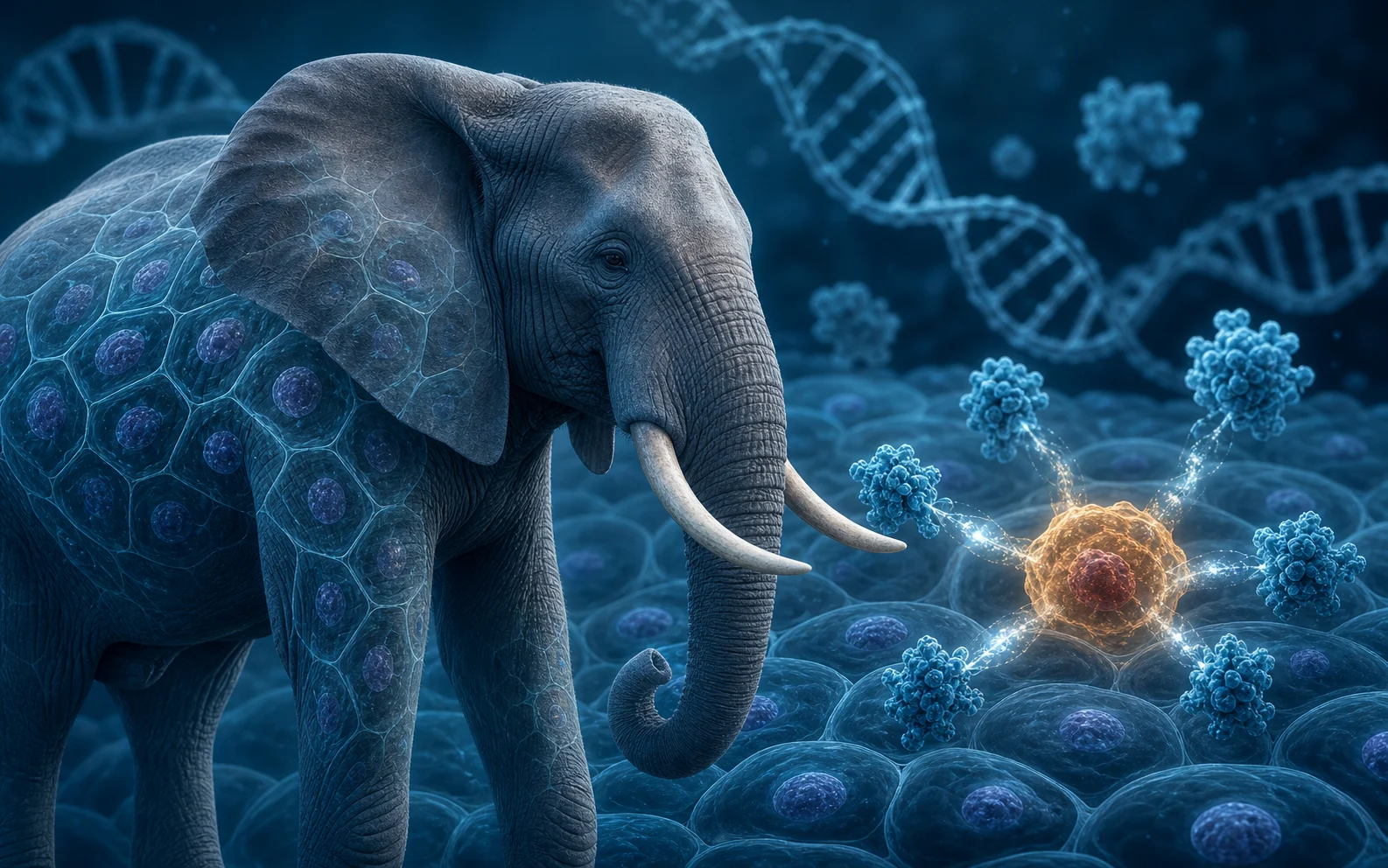
An elephant can live for about 70 years and reach up to 6 tons. Such a large organism has trillions of cells and countless cell divisions during its lifespan. Logically, an organism with so many cells would be expected to develop cancer more frequently than humans.
However, nature presents a surprising twist here.
For many years, scientists have known that despite their size and long lifespans, elephants have much lower cancer rates than expected. This phenomenon is called the “Peto's Paradox” in the scientific world: if cancer risk is directly proportional to the number of cells, why don't elephants and whales die of cancer?
The most significant answer shown by research is a gene called TP53.
TP53 acts like a security guard for our cells. When DNA damage occurs, it detects it, halts the cell cycle, and attempts to repair the damage. If the damage is too severe, it triggers programmed cell death, preventing the cell from becoming cancerous. For this reason, the TP53 gene is frequently referred to in the scientific world as the “guardian of the genome”.
While humans have one functional copy of this gene, elephants possess approximately 20 copies of TP53. These extra copies help elephant cells detect DNA damage much faster and eliminate risky cells earlier.
When researchers exposed elephant cells to DNA-damaging conditions, they encountered an interesting result. Elephant cells initiated programmed cell death (apoptosis) much faster than human cells when damaged. In other words, elephant cells prefer to eliminate a suspicious cell early rather than keeping it alive.
This mechanism may be a product of millions of years of evolution. Because having a large body means more cells and a higher risk of mutation. Nature seems to have provided elephants with a stronger biological defense system in response.
Of course, elephants are not completely immune to cancer. However, thanks to their advanced cellular defense mechanisms, they have much lower cancer rates than expected given their size. Today, scientists are studying this natural protection system of elephants to find new clues for future cancer treatments.
Perhaps one of the most important lessons we need to learn in the fight against cancer comes from these giant creatures quietly roaming the African savannas.